Study Skills System: Focus, Memory & Better Sessions
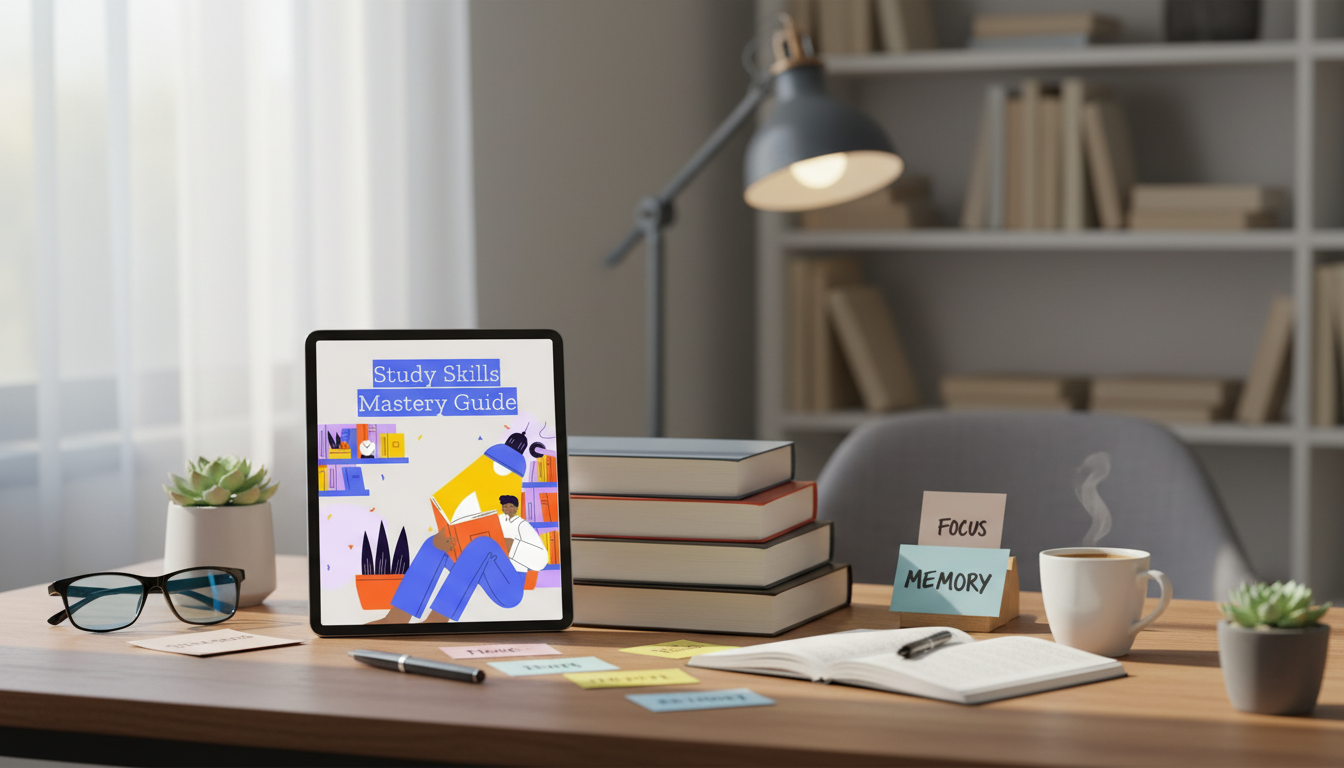
Study Skills Mastery Guide: A Practical System for Focus, Memory, and Better Study Sessions
Strong study results come from a repeatable system: clear goals, focused work blocks, proven memory practice, and a simple checklist that removes guesswork. This guide breaks study skills into steps that are easy to apply for school, exams, and self-paced learning—plus a ready-to-use checklist and templates you can keep on your device.
What “study skills” actually include (and what to stop doing)
Real study skills are more than “spending time with notes.” They’re a full workflow: planning, attention control, learning techniques, review habits, and test execution. When any one of those breaks down, effort rises while results stall.
Common traps include rereading the same pages, highlighting without testing yourself, cramming without spaced review, and “studying” while switching between apps and notifications. A stronger baseline is simple and reliable: short focused sessions, active recall, spaced repetition, and practice questions—approaches supported by learning research like Dunlosky et al. (2013) (review of effective learning techniques).
Set up a study plan that survives busy weeks
Plans fail when they’re vague or too big. Start with outcomes and translate them into small “next actions” that fit a single work block.
- Define what “done” looks like: chapters mastered, problem sets completed, or a practice test score target.
- Break work into block-sized actions: “quiz myself on terms 1–30” beats “study biology.”
- Run a weekly review: pick 2–3 priority topics, schedule sessions, and pre-decide what gets skipped if time shrinks.
- Keep one capture list: dump questions and to-dos that pop up while studying so they don’t hijack your session.
For additional test-taking structure and study strategy references, Purdue OWL has a practical overview (Study Skills and Test-Taking Strategies).
Focus tactics that work when motivation doesn’t
Motivation is unreliable; environments and timers are reliable. Make focus the default by reducing friction and making distraction inconvenient.
- Go low-friction: open only required tabs/apps, clear the desk, and prep water/snacks before you start.
- Use timed blocks: 25/5 or 45/10. Define one measurable task per block.
- Stop attention leaks: silence notifications, keep your phone out of reach, use full-screen or site blockers during blocks.
- Create a start ritual: same playlist, same timer, and a first “two-minute task” to bypass procrastination.
Quick focus fixes by situation
| Situation | What to do in 2 minutes | Why it helps |
|---|---|---|
| Can’t start | Write the smallest next step and set a 10-minute timer | Lowers activation energy and creates momentum |
| Keep checking phone | Put phone in another room and turn on Do Not Disturb | Removes the strongest cue for distraction |
| Mind keeps wandering | Switch to active recall: close notes and quiz yourself | Forces engagement and reveals gaps |
| Overwhelmed by workload | List tasks, circle the top 1–2, schedule the rest | Restores control and prevents avoidance |
| Studying feels pointless | Connect to a goal: exam score, project outcome, skill use-case | Improves persistence and prioritization |
Study methods that improve learning (not just time spent)
Effective studying looks harder because it requires retrieval, decision-making, and feedback. That “desirable difficulty” is what makes learning stick.
- Active recall: close materials and retrieve key ideas from memory (free recall, flashcards, self-quiz, teach-back).
- Spaced repetition: revisit material over days/weeks to strengthen long-term retention.
- Interleaving: mix problem types or topics to build discrimination and flexible use of knowledge.
- Worked examples → fading: study solved problems, then remove steps until you solve independently.
- Practice under test-like conditions: timed sets, no notes, then review errors for patterns.
Memory techniques for fast recall under pressure
When you need quick access—during exams, presentations, or timed problem sets—memory strategies help you retrieve accurately without panic.
- Chunking: group items into meaningful units (concept clusters, formula families, timelines).
- Elaboration: ask “why is this true?” and “how does it connect?” then write short explanations in your own words.
- Dual coding: pair words with simple diagrams, flowcharts, or concept maps (skip decorative visuals).
- Mnemonics: acronyms, method of loci, peg systems—best for lists and sequences, not deep understanding.
- Error logs: track recurring mistakes and convert them into mini-drills for spaced practice.
A simple checklist for every study session
A checklist reduces decision fatigue: you spend less time “setting up” and more time learning.
Using a digital guide to stay consistent
Study Skills Mastery Guide: what’s inside and who it fits best
If you want one structured system that ties together planning, focus, learning methods, and memory practice, the Study Skills Mastery Guide (digital download) is designed for session-by-session use. It fits students and self-learners preparing for exams, managing semester-long classes, or building consistent skill routines.
For focus support that starts before you even open your notes, quality sleep is a performance multiplier. The APA highlights sleep’s role in health and well-being (APA: the importance of sleep). If winding down is the bottleneck, Sleep Reset guided audio course can pair well with your study routine by helping you protect recovery time.
Build a 7-day reset plan (quick start)
FAQ
What’s the most effective study method for long-term memory?
Active recall combined with spaced repetition is one of the most reliable ways to build long-term retention. Rereading feels productive because it’s familiar, but testing yourself and revisiting later (same day, 2 days later, 1 week later) creates stronger memory traces.
How many hours should a study session be?
Aim for focused blocks of 25–45 minutes with short breaks, then repeat if needed. Total hours depend on course load, but quality (retrieval practice and targeted review) matters more than marathon sessions.
Can a digital study guide replace tutoring or a course?
A digital guide supports your process and consistency, but it works best alongside course materials or tutoring. Use it to plan sessions, practice retrieval, and track weak areas so help—when you need it—is more targeted.












Leave a comment